Here at London Sports Physiotherapy we have years of experience successfully treating meniscus injuries both conservatively and post-operatively. From young sporting meniscus tears to older and more degenerative meniscus tears, each meniscus injury is managed with an individual treatment plan. No person and no injury is the same. Prognosis and management will depend on the location and type of tear along with the individuals history, mechanism-of-injury, pain-levels, functional ability and personal goals and objectives.
This blog provides an in-depth look at the factors that matter most with meniscus injuries and tears. If you think you have experienced a meniscus injury, if an MRI has confirmed a tear or if you would like an assessment from one of our expert physiotherapist’s to rule out a meniscus injury, do not hesitate to book your appointment today.
1. What Are Meniscus Injuries?
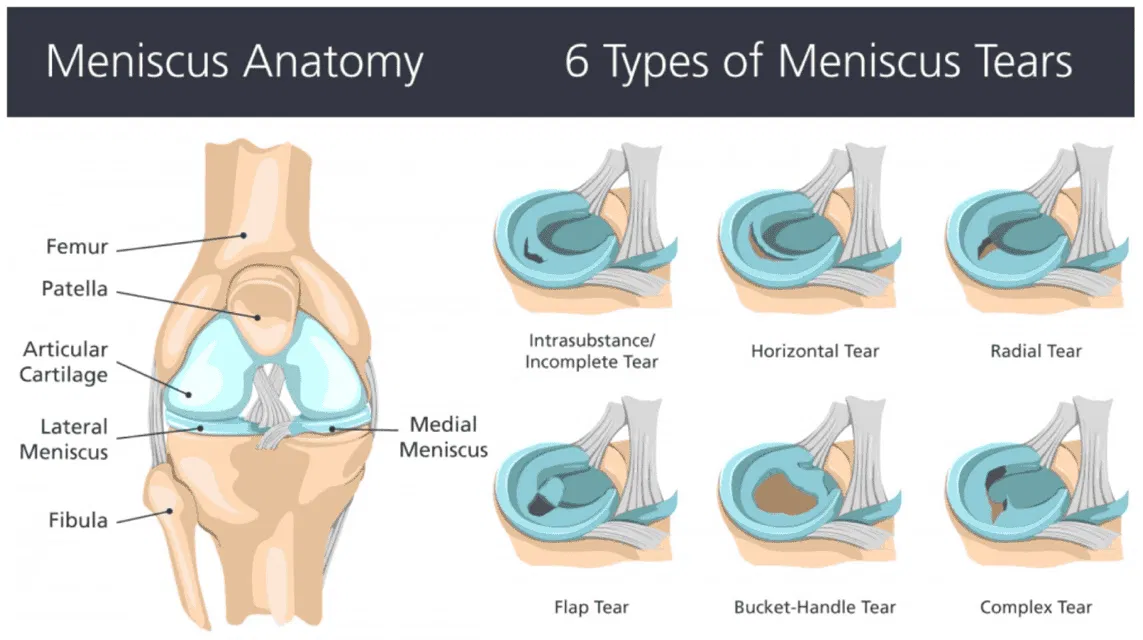
The meniscus is one of the most important structures in the knee joint. Each knee contains two crescent-shaped pieces of fibrocartilage, the medial meniscus (on the inner side) and the lateral meniscus (on the outer side). They sit between the femur (thigh bone) and tibia (shin bone). Their primary roles are to absorb shock, distribute load, stabilise the joint, and facilitate smooth, pain-free movement. Every time you move a joint a lubricant called synovial fluid helps nourish and oil the joint, this is why we are often stiff in the morning until we get moving a little.
The meniscus helps distribute synovial fluid too, they have many really important functions.
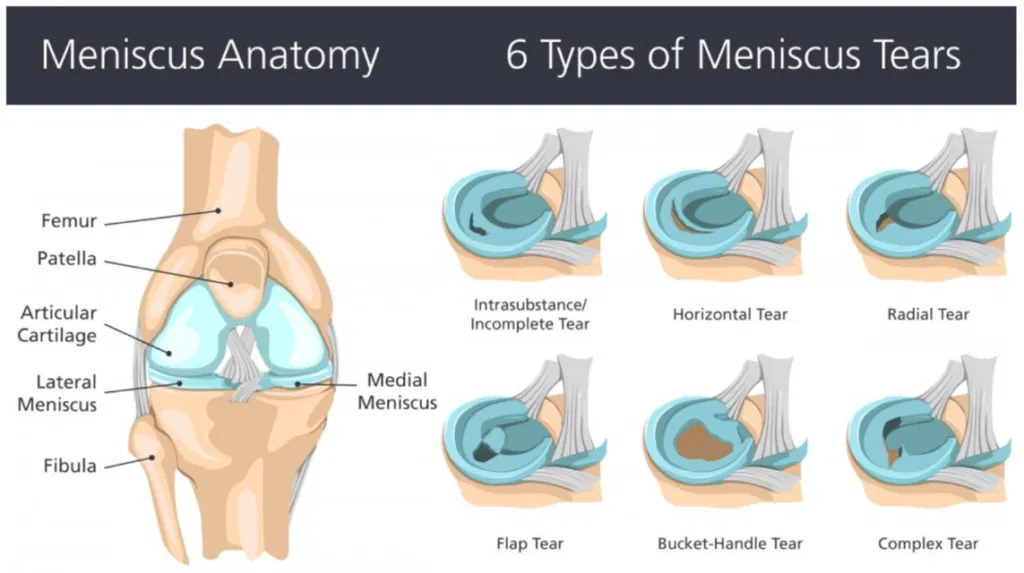
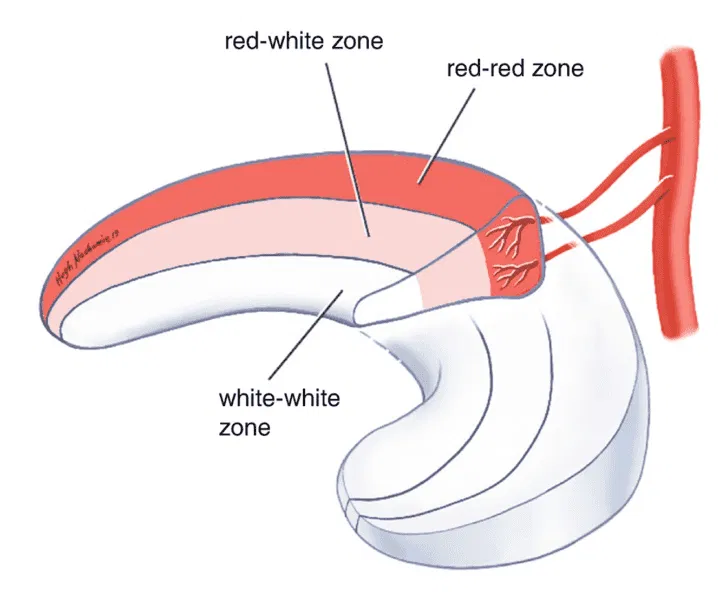
Meniscus is predominantly composed of collagen (75%). The remainder being small quantities of sGAG (17%) and DNA (2%). Understanding the anatomy of the meniscus is helpful when discussing injury and healing. The meniscus is divided into three distinct zones based on their proximity to the blood supply: the red-red zone (outer third), the red-white zone (middle third), and the white-white zone (inner third). The red-red zone has the richest vascular supply, meaning tears in this region have the greatest potential to heal naturally with appropriate conservative treatment. The white-white zone, by contrast, is largely avascular and relies on the presence of synovial fluid for nutrition. Tears in the white-white zone are significantly harder to heal without surgical intervention. The red-white zone sits in between and has moderate healing potential.
Collagen fiber orientation of the outer aspect of the red-red zone is vertical, supporting axial loading and weight through the knee from top-to-bottom. The inner more avascular areas are made up of horizontal and randomly orientated collagen fibers, supporting rotational and twisting movements.
Not all meniscus tears are the same, and the zone in which the tear occurs plays a major role in determining the most appropriate course of treatment.
2. What Causes Meniscus Injuries?
Meniscus injuries are among the most common knee injuries seen in both active individuals and the general population in Sutton, South London and across the UK. They can occur as a result of acute trauma or through gradual degenerative change over time.
Acute tears typically occur during sport or physical activity and often involve a sudden twisting or pivoting movement with the foot planted. They are common in football, rugby, tennis, basketball, and skiing. Deep squatting, heavy lifting, or a direct blow to the knee can also cause a tear.
Degenerative tears develop more gradually and are frequently associated with the natural ageing process. Over time, the meniscal tissue becomes less resilient and more susceptible to tearing, even from relatively minor movements such as getting up from a chair or stepping awkwardly off a kerb.
Other contributing factors include previous knee injuries, muscle weakness around the knee (particularly the quadriceps and hamstrings), poor movement mechanics, obesity, and occupations or activities that place repetitive stress on the knee joint.
3. Signs and Symptoms of Meniscus Injuries
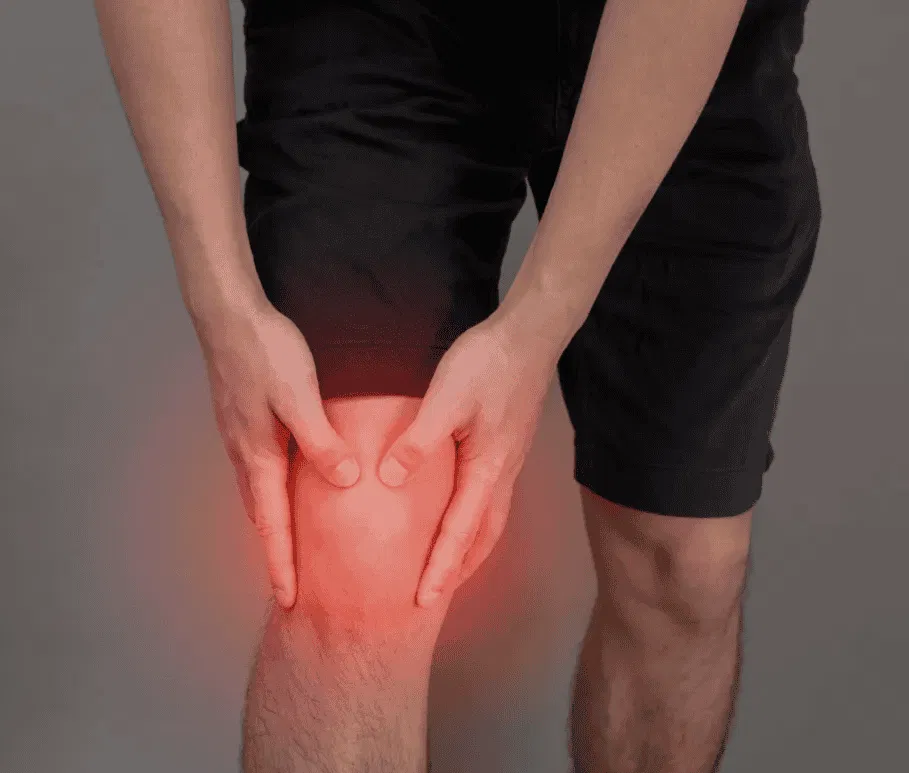
The symptoms of a meniscus injury can vary considerably depending on the type, severity, and location of the tear. Common signs and symptoms include:
- Pain along the inner or outer joint line of the knee, often worsening with twisting, squatting, or deep flexion
- Swelling of the knee, which may develop gradually over 24–72 hours
- Stiffness and reduced range of motion
- Clicking, catching, or popping sensations during movement
- Locking of the knee, an inability to fully straighten the joint, caused by a torn fragment becoming lodged in the joint space
- Giving way, a feeling that the knee is buckling or unstable during weight-bearing activities
It is important to note that some people with meniscus tears experience minimal or no pain, particularly in the early stages of degenerative tears. Equally, symptoms that initially appear severe often respond very well to physiotherapy without the need for surgery.
4. How Are Meniscus Injuries Diagnosed?
Accurate diagnosis is the foundation of effective treatment. At London Sports Physiotherapy, our expert clinicians conduct a thorough and systematic assessment to determine the nature and extent of any meniscus injury.
A clinical examination will include a detailed history of how and when the injury occurred, alongside a series of specific orthopaedic tests (McMurray test, Thessaly test, and Apley’s compression test for example) which are designed to reproduce symptoms and identify meniscal pathology.
Where further information is required, imaging may be recommended. We are able to offer point-of-care diagnostic ultrasound scans in clinic where appropriate, however ultrasound is often not the imaging modality of choice concerning the knee due to its inability to identify deep structures of the knee such as the medial meniscus, lateral meniscus and cruciate ligaments (anterior cruciate ligament (ACL) and posterior cruciate ligament (PCL))
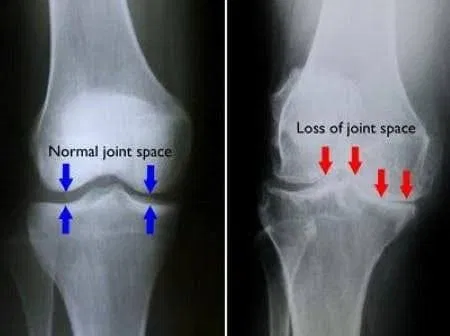
An MRI scan is the gold standard for visualising soft tissue structures including the meniscus, and can confirm the location, type, and severity of a tear. A weight-bearing x-ray may also be helpful to rule out bony involvement or assess for arthritic changes.
Objective assessment does not stop there. At London Sports Physiotherapy, we utilise state-of-the-art VALD strength testing equipment to quantify limb strength, identify asymmetries, and establish a precise baseline from which to monitor your recovery progress. This level of objective data allows us to tailor treatment with precision and ensure your rehabilitation is evidence-based from day one.
5. Treatment Options for Meniscus Injuries
A common misconception is that meniscus tears always require surgery. In reality, the vast majority of meniscus tears particularly those in the vascularised red-red zone, or degenerative tears, can be managed effectively with expert conservative treatment. Surgery is generally only indicated in cases where there is true mechanical locking (where the knee cannot fully straighten), significant giving way that fails to resolve with rehabilitation, suggesting a displaced or unstable tear that is mechanically disrupting the joint, or where someone is experiencing persistent pain despite optimal conservative management.
Physiotherapy remains the cornerstone of meniscus rehabilitation. A key biological principle underpinning recovery is mechanotransduction, the process by which mechanical forces applied to tissue stimulate cellular activity, promote collagen synthesis, and facilitate healing. In practical terms, this means that carefully graded, progressive loading of the knee through targeted exercises is not only safe but actively accelerates tissue repair. Avoiding all movement is counterproductive; the right movement, at the right intensity and stage, is therapeutic.
At London Sports Physiotherapy our treatment approach is comprehensive and highly individualised. Depending on your specific needs, it may include:
- Manual therapy to restore joint mobility and reduce pain
- Progressive rehabilitation exercises targeting quadriceps strength, hamstring flexibility, and lower limb biomechanics
- Occlusion Blood Flow Restriction (BFR) training, a highly effective technique that uses a specialised cuff to partially restrict venous blood flow, allowing significant muscle hypertrophy and strength gains at lower training loads. This is particularly valuable in the early post-injury phase when heavy loading may not yet be appropriate
- Electrical Muscle Stimulation (EMS) to enhance quadriceps activation, particularly where significant muscle inhibition is present following injury or swelling
- Steroid injections to reduce inflammation and pain in the acute phase, facilitating earlier participation in rehabilitation
- Hyaluronic acid (HA) injections to improve joint lubrication, reduce pain, and support the articular environment, especially useful in cases where degenerative change accompanies the meniscal injury
6. How Can London Sports Physiotherapy Help?
London Sports Physiotherapy is a specialist clinic with outstanding expertise in the assessment and treatment of knee injuries, including meniscus tears at every stage, from acute injury through to return to sport or full function. We understand that knee pain can be debilitating, and we are committed to providing the highest quality of care to every individual who comes through our doors.
Our clinicians are highly skilled in clinical assessment and exercise prescription, combining hands-on treatment with cutting-edge technology. The VALD dynamometer allows us to objectively measure and track your strength throughout your recovery, giving both clinician and client clear, data-driven progress markers. Our use of BFR training and EMS ensures that muscle strength and neuromuscular function are optimised at every stage of rehabilitation, even when conventional loading may be limited.
For those who require an additional layer of support, our steroid and hyaluronic acid injection service provides fast, targeted relief and creates the optimal biological environment for healing and rehabilitation to take effect.
We also have excellent contact-links and close networks with top Orthopaedic knee consultants in the local area, both in the NHS and privately in hospitals such as Shirley Oaks Hospital and Spire St. Anthony’s. This is due to our years of experience working in the NHS and private sector in the Sutton and South London areas. A surgical opinion is just a phone call away, and we often liaise closely with Orthopaedics both pre and post-surgery too.
At London Sports Physiotherapy we have aligned ourselves with leading Orthopaedic consultants in London. You will notice we are clinic partners with many top consultants including Mr Bobby Anand (Surrey Knee Surgeon), Mr Rhee (Shoulder and upper limb surgeon), Mr Kunasingam (Foot and Ankle surgeon), Mr Kotrba (Spinal surgeon) and Dr Gautham Srinivisan (Pain consultant).
Whether you are a competitive athlete in London aiming to return to peak performance, or someone simply wanting to walk and live without knee pain, London Sports Physiotherapy has the expertise, technology, and clinical excellence to get you there. Our holistic, client-centred approach means that your care is never one-size-fits-all, it is built around you.
Other common injuries to the knee include osteoarthritis, patello-femoral joint pain, runners’ knee, anterior cruciate ligament (ACL) tears, medical collateral ligament (MCL) tears, patella tendinopathy, osgood-schlatters disease and Sinding-Larsen-Johansson syndrome. For information on these injuries please click on the above links or return to the LSP Academy section.
Frequently Asked Questions
Not necessarily. The majority of meniscus tears respond very well to physiotherapy, particularly if there is no mechanical locking or persistent giving way. Surgery is typically considered only when conservative treatment has failed or when there is clear evidence of a displaced, unstable tear causing mechanical symptoms.
Healing time varies considerably depending on the type, zone, and severity of the tear. Minor tears in the vascularised red-red zone may recover within 6–8 weeks. More complex tears or those in the avascular white-white zone may take several months. Your physiotherapist will provide a personalised timeframe based on your individual assessment.
Yes. In most cases, carefully guided exercise is not only safe but essential for recovery. Mechanotransduction means that progressive loading helps stimulate tissue healing. Your physiotherapist will design a programme that is appropriate for your stage of recovery.
Blood Flow Restriction (BFR) training involves applying a cuff around the upper limb or thigh to partially restrict venous outflow during exercise. This allows you to achieve significant muscle strengthening at much lower resistance levels, making it ideal during early rehabilitation when heavy loading may be uncomfortable or inappropriate.
Yes. “Torn cartilage” is the common term used to describe a meniscus tear. The meniscus is made of fibrocartilage, so the terms are often used interchangeably.
London Sports Physiotherapy is based in Sutton, South London. Get in touch today to book your comprehensive knee assessment and begin your personalised recovery programme.
London Sports Physiotherapy — Specialist Knee and Running Injury Clinic in London. Expert assessment, diagnostic ultrasound, state-of-the-art rehabilitation technology and outstanding clinical care.