Written by Josh Hawksworth, Co-Director & Specialist Physiotherapist | London Sports Physio, Sutton
If you have ever asked me “when can I go back to training?” or “how long will this take?” you are not alone. These are the most common questions I hear from injured athletes here at London Sports Physio in Sutton. And the honest answer is: it depends — not on a fixed number of weeks, but on where your body is right now versus where it needs to be.
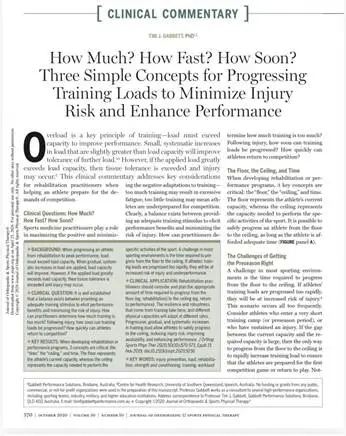
A landmark paper by Professor Tim Gabbett, published in the Journal of Orthopaedic and Sports Physical Therapy in 2020, gives us some of the clearest evidence yet for how to answer those questions. I want to walk you through what the research says, and explain exactly how it influences the way we approach sports injury rehab in Sutton and South London at our clinic.
Who Is Professor Tim Gabbett?
Before diving into the research, it is worth knowing a little about the man behind it. Professor Tim Gabbett is one of the most cited sports scientists in the world, based in Brisbane, Australia, and affiliated with the University of Southern Queensland. Over more than two decades, his research has transformed how elite clubs, national teams, and physiotherapists think about training load and injury prevention.
Gabbett is perhaps best known for developing the acute:chronic workload ratio, a method for tracking how much an athlete has done recently compared to what they are accustomed to, and for demonstrating something counterintuitive: that well-trained athletes are actually less likely to get injured, not more. His work underpins the way elite sports medicine operates globally, and it directly informs the way I work with clients here in Sutton.
The Research: Three Simple Questions, One Powerful Framework
Gabbett’s 2020 clinical commentary titled How Much? How Fast? How Soon? poses three questions that sit at the heart of every sports rehabilitation programme:
• How much training load should an injured athlete be given?
• How fast should those loads be increased?
• How soon can they return to competition?
His answer revolves around two concepts that I now use in every single rehabilitation plan I write: the floor and the ceiling.
The Floor and the Ceiling
The floor is where the athlete is right now, their current physical capacity at the start of rehabilitation. The ceiling is where they need to be to safely handle the full demands of their sport at the highest level they play. The entire rehabilitation journey sits in the space between those two points.
This framework seems simple, but it is genuinely transformative in practice. It shifts the focus away from the injury itself (the diagnosis, the pain, the scan) and towards a measurable goal: can this athlete’s body handle what their sport will ask of it?
Load Progression: The Key to Safe Return to Sport
Gabbett is clear that for rehabilitation to work, training load must exceed current capacity. This is how the body adapts and grows stronger. But the rate at which you increase that load is everything. When load is increased gradually and systematically, tissue tolerance improves in step. When it is increased too rapidly, you exceed what the body can handle, and injury occurs. Often a recurrence of the original problem, or a new injury entirely.
This is one of the most important things I try to communicate to clients and athletes who are eager to return to training quickly. Feeling better is not the same as being ready. Pain is a very imperfect indicator of physical capacity, and the absence of pain does not mean the tissue has fully adapted to load.
The Challenge of Time
Perhaps the most important insight in the paper is this: different physical structures adapt at different rates. Muscle strength can return relatively quickly. But tendon stiffness, bone density, and neuromuscular coordination operate on longer timescales. An athlete who looks and feels match-fit may still have a tendon or a ligament that is not yet prepared for the explosive, high-speed demands of competition.
Gabbett is unambiguous: if you progress rehabilitation loads too rapidly, you increase both injury risk and the likelihood of underperformance. The pressure to return quickly from coaches, clubs, or the athlete themselves, is one of the most common reasons athletes end up back on the treatment table.
What This Means for Sports Injury Rehab at London Sports Physio, Sutton
This research directly validates the approach we take to sports injury rehab in Sutton and South London. Let me explain how it translates into our day-to-day clinical practice.
Objective Strength Testing with VALD Technology
One of the things I am most proud of at London Sports Physio is our use of VALD objective strength testing. We ensure all of our physiotherapists are well-trained and experts in using VALD Technology. It allows us to precisely measure where clients sit on the floor-to-ceiling spectrum at any point in their rehabilitation. Rather than relying on how someone feels on a given day, we can quantify limb symmetry, force output, and movement quality, giving us a genuinely data-driven basis for every return-to-sport decision we make.
This is Gabbett’s framework made practical. Instead of guessing, we measure.
Blood Flow Restriction and EMS: Raising the Floor Faster
Our use of blood flow restriction (BFR) training and electrical muscle stimulation (EMS) also sits squarely within this evidence base. Both techniques allow us to drive meaningful physiological adaptation, building strength and tissue resilience, even in the very early stages of rehabilitation when full loading is not yet appropriate. In effect, they help us raise the floor more efficiently, closing the gap between where the client is and where they need to be.
No Fixed Timelines — Individual Readiness Standards
Whether I am working with a footballer recovering from an ACL reconstruction, a runner rehabilitating a hamstring tear, or a client following knee replacement surgery or severe osteoarthritis, the principle is the same: return to sport or activity is not a date on the calendar. It is a standard of physical readiness. At London Sports Physio in Sutton, every rehabilitation plan is built around objective markers of capacity, not arbitrary timelines.
Gabbett’s research gives me the evidence base to have that conversation with every athlete who comes through our door, and to hold the line when the pressure to return early starts to mount.
Key Takeaways
• Rehabilitation is about bridging the gap between your current capacity (the floor) and the demands of your sport (the ceiling).
• Load must progressively increase for the body to adapt, but the rate of increase matters enormously.
• Feeling better is not the same as being ready. Different tissues adapt at different rates.
• Objective measurement (not pain levels alone) should drive return-to-sport decisions.
• At London Sports Physio, we use VALD strength testing, BFR training, and EMS alongside functional testing such as the triple-hop-test for example to make rehabilitation as evidence-based and efficient as possible.
Ready to Start Your Sports Injury Rehab in Sutton or South London?
If you are recovering from a sports injury and want to return to play at the highest level, safely and with confidence, our team at London Sports Physio in Sutton is here to help. We offer elite-level rehabilitation using the latest evidence and technology, with same-week appointments available.
If you’d like support, you can:
- Book an appointment with our physiotherapy team in Sutton
- Learn more about our Sports Injury Rehabilitation service (Hyperlink to Sports Injuries page)
We’re here to help you move forward with confidence.
Same-week appointments available. Monday to Friday 9am–8pm and Saturday mornings.
Call us on 0203 092 5464 or email hello@londonsportsphysio.com.
Reference: Gabbett TJ. How Much? How Fast? How Soon? Three Simple Concepts for Progressing Training Loads to Minimize Injury Risk and Enhance Performance. J Orthop Sports Phys Ther. 2020;50(10):570–573. doi:10.2519/jospt.2020.9256